


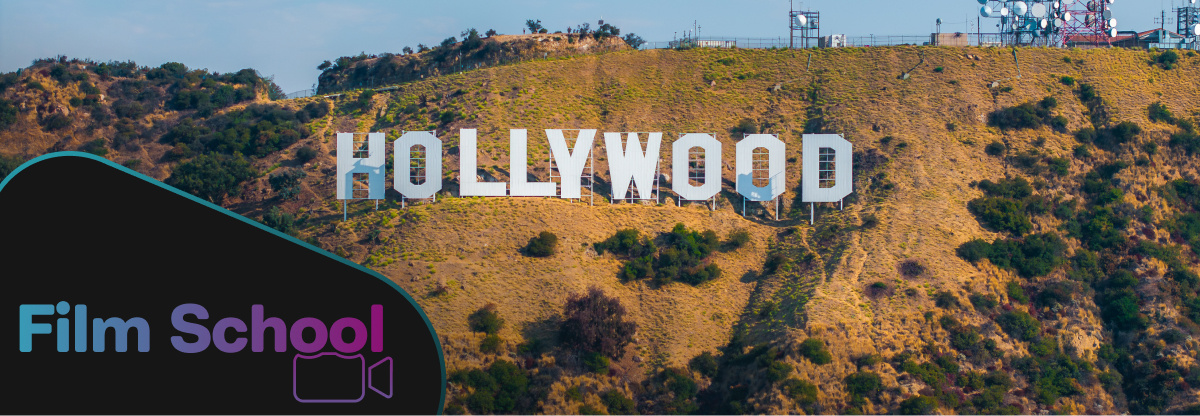
The rapid advancement of technology has become a societal and cultural norm, but it wasn’t always this way. Though “The Golden Age of Hollywood” marks an iconic era of cinematic innovation, it was not without turmoil, which fueled its eventual decline.
Still, the dominant and defining “Big Five” production studios paved the way for what is now a $77 billion global film industry. Here, we’ll explore the history behind Hollywood cinematography, the rise, fall, and eternal legacy of its Golden Age.
What is the Golden Age of Hollywood?

Whether you’re a film savant, cinema connoisseur, or movie novice, you’ve likely been touched by the magic of the Hollywood cinema industry. Most everyone knows about films like “The Wizard of Oz” (1939), “Casablanca” (1942), “Gone with the Wind” (1939), and “King Kong” (1933), either from the big screen or cultural reference. But how and why did those films become cultural references in the first place?
History of Hollywood's film industry
The Golden Era of Hollywood began in the late 1910s, though many credit D.W. Griffith’s, “The Birth of a Nation” (1915), as its first influential (silent) film. Others attribute the feature film, “The Jazz Singer” (1927), to be the official start to the Hollywood Golden Age for its introduction to sound. This marked the end of the silent film era and the beginning of what’s called, the “talkies.”
Between 1930-1945 alone, at peak popularity, more than 7,500 feature films were released and over 80 million people consumed them. Beyond the sheer volume of motion picture films, however, the answer to the question, What is the Golden Age of Hollywood, is more complex.

The history of Hollywood's film industry was shaped by the following four main influences:
1. Production technology advancements
The Hollywood Golden Age was defined by its evolution of picture quality and sound, breeding a narrative and visual filmmaking style that is forever known as “classic Hollywood cinematography.”
2. Big Five studios
The “Big Five” studios — Metro-Goldwyn-Mayer (MGM), RKO Radio Pictures, 20th Century Fox, Warner Bros., and Paramount Pictures — monopolized, controlled, and dominated all aspects of film production and exhibition.
There were three additional players in the game, called “The Little Three:” Universal Pictures, Colombia, and United Artists. Though they didn’t have the same level of control as the Big Five, they did contribute to the innovation of production technology. Together, all eight players commanded 95% of the market.
Despite the eventual decline of the Hollywood Golden Age in the late 1940s, today’s Big Five major studios — Universal Pictures, Paramount Pictures, Warner Bros., Walt Disney Studios, and Sony Pictures — still echo its legacy.
3. Star system
Though each studio made their own specific contributions to the Hollywood Golden Age, MGM, the largest production studio, was responsible for fostering famous actors under a methodical “star system.”
Hollywood cinematography icons like Katharine Hepburn, Cary Grant, Joan Crawford, Bette Davis, and Humphrey Bogart were repeatedly cast to boost box office sales and consumer interest.
4. Economic conditions
At the height of the Great Depression, the Hollywood Golden Age served as a means of affordable respite. The roaring 20s gave way to disposable income for entertainment, consumer goods, and fashion, but when the stock market crashed in 1929, people sought economical escapes and found it in film. In fact, the Big Five intentionally drove content and strategic ticket prices to serve the downtrodden masses.
The power of media is a fact of society and proves even truer today with rapid advances such as AI and social media. As society changes, the media and related industries change to reflect relevance.
As the saying goes, That’s showbiz. Inherent within it lives a strategic business model, but these films were also lifelines for consumers back then. The technology, economy, and stardom embedded within classic Hollywood cinematography reflects an unrepeatable time in history, and because of that, will live on forever.
Iconic films from the Golden Age of Hollywood
 Image via Warner Bros.
Not only did the Golden Era of Hollywood substantiate names like Charles Chaplin, Judy Garland, Fred Astaire, and countless others still found on Hollywood’s Walk of Fame, but the contributions of directors like Alfred Hitchcock, John Ford, and William Wyler have become timeless, too.
The following films are some of the most notable for its time:
Classic Hollywood cinema: 1930s
- King Kong (1933), Directed by Merian C. Cooper
- It Happened One Night (1934), Directed by Frank Capra
- The Adventures of Robin Hood (1938), Directed by Michael Curtiz
- Wuthering Heights (1939), Directed by William Wyler
- Stagecoach (1939), Directed by John Ford
- The Wizard of Oz (1939), Directed by Victor Fleming
Classic Hollywood cinema: 1940s
- Rebecca (1940), Directed by Alfred Hitchcock
- Citizen Kane (1941), Directed by Orson Welles
- The Maltese Falcon (1941), Directed by John Huston
- Casablanca (1942), Directed by Michael Curtiz
- Mildred Pierce (1945), Directed by Michael Curtiz
- It’s a Wonderful Life (1946), Directed by Frank Capra
Classic Hollywood cinema: 1950s
- A Streetcar Named Desire (1951), Directed by Elia Kazan
- Singin’ in the Rain (1952), Directed by Stanley Donlen
- Roman Holiday (1953), Directed by William Wyler
- Rear Window (1954), Directed by Alfred Hitchcock
- Rebel Without a Cause (1955), Directed by Nicholas Ray
- North by Northwest (1959), Directed by Alfred Hitchcock
Among these films, there are countless Hollywood cinematography techniques that remain foundational to visual storytelling, such as: Video edits like the 180-degree rule, character-driven narratives, studio lighting methods, green screens, and so much more.
When the original Big Five ruled Hollywood
Though known as “The Big Five” for their collective impact in the film industry, each production studio distinctly influenced the Hollywood cinema industry. For example, Paramount Pictures, established in 1912, was (and still is) known for promoting major star-laden cinemas, whereas MGM and RKO blended musicals with film.
Warner Bros. pioneered sound with “The Jazz Singer” (1927), later pivoting towards animation and gangster films. Lastly, 20th Century Fox — now known as 20th Century Studios — was the biggest financial rival to MGM, producing western films, biographies, musicals, and religious epics.
While the Hollywood Golden Age suggests prosperous times — and in some respects, they were — there were also looming shadows on the horizon. As the saying goes, All good things must come to an end. And as all narrative arcs foretell, for every rise, comes the inevitable fall.
The eventual decline of the Golden Age of Hollywood

Though the Golden Era of Hollywood and its cinematography may influence film for eternity, the rise itself couldn’t last forever. Its decline officially began in 1948 due to various societal and economic changes. Below are three main contributing factors that led to the fall of Hollywood, the Golden Age.
1. Birth of television
Antitrust regulations forced changes upon the film industry as prime-time television made its way into homes. Federal laws prohibited the Big Five studios from merging film and TV together, monitoring how industries did business.
These laws allowed the TV industry to become a strategic competitor, though it limited available resources for film.
2. Hays Code
The Hays Code is responsible for censoring particular content from TV and film in order to uphold societal values. For the Hollywood cinema industry at this time, this included refraining from: profanities, drug use, glorifying crime, displaying married couples in bed, disrespecting religion or law, etc.
Of course, as societal norms evolve, what’s considered “appropriate” also evolves and film mirrors this accordingly. Though guidelines are necessary, the Hays Code confined creativity, expression, and ultimately, the potential to continue reaching its audience.
3. Court rulings
In addition to these industry shifts, the Supreme Court also decided to dismantle the studio system, forcing the Big Five to sell their theaters and restrict future production. Among rising costs, stars becoming free agents, and major TV studios consuming airtime, the Golden Era in Hollywood reached its inevitable end.
Still, the modern film industry is reminiscent of Hollywood’s Golden Age system. The big players are still playing, Hollywood stardom is alive and well, and the Golden Age’s legacy is prevalent in every award ceremony that honors those who have come before.
Hollywood cinematography still informs visual storytelling
The magic of film is that it can transport anyone to any time period in an instant. In that sense, the Golden Age of Hollywood was not so long ago, as it continues to inspire modern Hollywood cinematography, film, filmmakers, and the standout techniques that inform who takes home Academy Awards, Golden Globes, and Oscars every year.
As technology continues to evolve, so does the innovation behind it. Through history’s lasting legacies that now pave the way forward in film, there’s no limit to the potential of this industry or its impact.