


Every year, school districts engage in a familiar ritual. They review their software stacks, look at adoption metrics, and ask a fundamental question: Is this working?
For too long, the digital ecosystem has answered with a dangerously low bar. In the rush to digitize classrooms, we conflated access with accountability and accepted passive metrics as proof of growth. A standard multimedia playlist or file upload can tell an administrator that a student clicked a link or played a video to its final second.
But let’s be clear: lesson completion is not comprehension.
A finished progress bar only proves a student sat in front of a glowing screen; it cannot tell you if the concept actually took root. When we rely on passive checkmarks, we aren't measuring education, we are measuring compliance. To measure true growth, educators don't need heavier digital filing cabinets. They need sharp, native tools built to evaluate comprehension in real time.
From Creation to Delivery: Preserving the Instructional Flow
Last month at WeVideo’s Engage Summit, the artistry on display from educators was inspiring. Teachers were building deeply engaging video projects, dynamic multimedia sequences, and visually stunning lessons. The raw materials for world-class learning were all there.
Yet beneath the brilliance, a structural flaw in the daily teaching workflow was obvious.
Even the most innovative educators hit a wall the moment creation ended and delivery began. To assign content, protect the learning sequence, or gather actionable data, they had to pause. They demo’d how to guide students out of the creative environment, open a dozen separate tabs, copy links, and log into disconnected systems just to verify that a lesson was finished.
When content lives in one tool and evaluation mechanics are trapped in another, context gets lost in the tab-switching shuffle.
This digital tennis match doesn't just exhaust teachers; it actively derails learning. Evidence of understanding shouldn't be a post-mortem report generated hours after the fact. To be meaningful, evaluation must be a live pulse woven directly into the experience.
Closing the Loop Where the Spark Happens
The core thesis of modern instructional design is simple: evaluation belongs exactly where the creation happens.
By injecting the vital mechanics of a lesson, sequencing, pacing, and feedback, directly into the workspace where students already work, we completely redefine what it means to track success. We close the loop between the spark of an idea and the proof of its mastery.
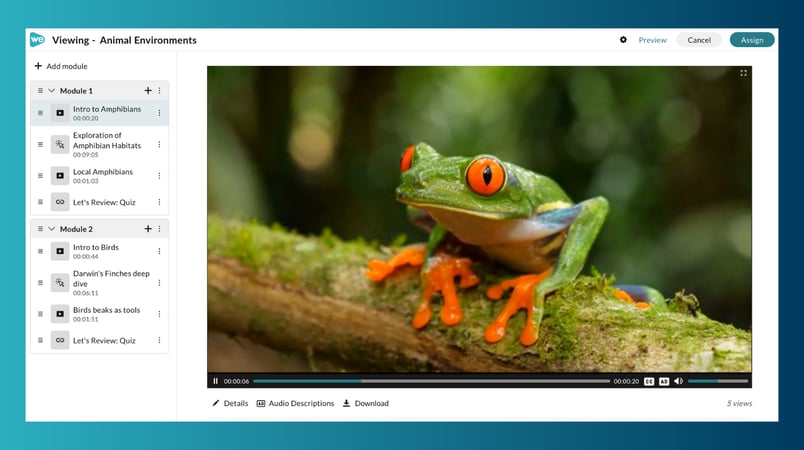
This exact challenge is what drove the development of Learning Path, WeVideo’s new feature designed to unify creation, delivery, and evaluation in a single workspace.
Instead of stringing together disjointed tools across multiple tabs, Learning Path allows educators to build fully sequenced multimedia lessons all in one spot.
By unifying these tools under one roof, Learning Path anchors three critical instructional pillars:
- Intentional Sequencing: It turns a scattered mix of videos, text readings, and interactive media into a single, guided student journey that preserves focus and context.
- Guardrails for Mastery: It gives educators the power to lock progression, ensuring a student genuinely understands a concept through native checks before the software opens the gate to the next step.
- Holistic Comprehension Insights: It replaces fragmented, disconnected quiz scores with a single, native dashboard that maps real understanding at a glance.
When lesson design and delivery happen in the same environment where learning occurs, context stays alive, letting educators spend less time managing links and more time driving growth.
Pedagogy Over Software Management
For district leaders, this shift toward native evaluation targets two of the most pressing crises in modern education: edtech budget bloat and chronic teacher burnout.
When the tool used to build a lesson is the same tool used to assign and track it, teachers win their time back. They stop troubleshooting integrations, fixing broken links, and fighting tab fatigue. Instead, they focus entirely on what matters most: diagnosing student needs and celebrating growth. Financially, it extracts far higher ROI from core creative platforms by maximizing what districts already own.
Edtech shouldn't force a choice between inspired lesson design and reliable accountability data.
The breakthrough happens when we combine the two, shortening the distance between expression and evaluation. When the tools we use to build are the tools we use to measure, the technology recedes into the background, leaving only clear evidence of student growth.
Explore Learning Path to streamline your lesson creation and assignment process, so you can spend time on what matters most: evaluating comprehension.