


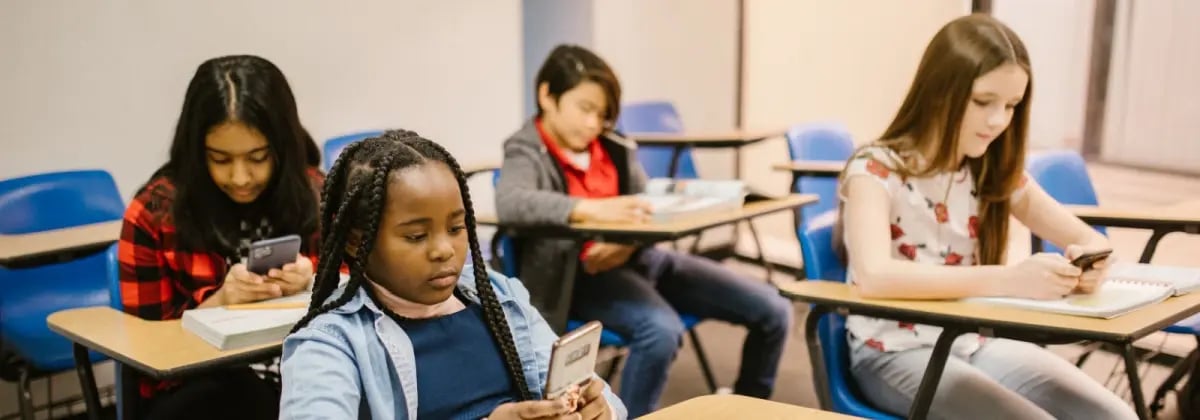
 You likely have one of two mindsets about AI: either you’re skeptical and are frustrated by the difficulties policing its use. Or you think it’s a powerful tool and are excited about all of the possibilities it can unlock. Either way, the toughest part of AI is that it’s technically so good in so many ways. But as humans, we also sense when something’s too perfect, and our intuition tells us it’s fake.
A study from 2024 indicates “58% of students admitted to using AI tools to complete assignments dishonestly.” With the advent and popularity of AI tools like ChatGPT, Claude, and Gemini, that statistic is very likely higher today.
So if you sense your students are turning in assignments that they didn’t fully complete themselves, but can’t prove it, what do you do?
You change the way the game is played by creating an AI-proof assignment.
What it means to be AI-proof
AI-proof assignments require authentic demonstration of understanding. Said in a different way, AI-proof assignments ask the student to show they truly understand the concept in a way that’s specific to them, or solve a problem in the context of the real world using their knowledge from the unit or curriculum.

Source: Unsplash.
Students take shortcuts for a variety of reasons stemming from boredom to busyness, so AI-proofing is, at its core, about giving students a reason to engage.
You can tell if your active learning video projects are AI-proof from these three markers:
- The assignment requires the student to use their voice, share their perspective, and show their presence.
- Rather than summarizing a concept, the AI-proof assignment centers around synthesis or creating a net-new idea.
- The output couldn’t be separated from the student because it’s produced within the context of the student’s own life and experiences.
Five AI-proof assignment designs that work for any subject
A WeVideo survey shows 84.8% of educators are “concerned” or “very concerned” about students using AI to bypass genuine understanding. But knowledge is always, as they say, power.
Now that we know what it means to AI-proof assignments, we can remove students’ cheat codes with tangible ideas. These five application ideas fit in well with video to bolster actual learning — not just performative assignments — for a wide range of subjects.
1. Explainer videos
Perhaps the most intuitive idea: have your students record themselves explaining a concept as if they’re talking to you.
For example, they tell you what photosynthesis is in their own words. For bonus points, they have to actually find a plant and show you where the plant takes in energy (the leaves), explain what happens during the chemical process (the plant creates glucose for energy), and where the plant releases oxygen (also the leaves).
2. Reflection vlogs
In these short-form video journals, students are required to time-stamp and document their learning process over time. Think of them as a video diary or check in.
These vlogs could be used to reflect on each chapter of a book (with requirements about what literary elements they notice). You might also use them after each section of a math class to reflect on what areas they feel like they understand, what they struggle with, etc.
3. Peer video response
Now, it’s time to take it to the group. In this option, students can respond and give feedback on each other’s work. Not only does this prompt students to show their critical thinking skills, but it also necessitates that the recipient of the feedback explain their decision making.
This could work for a science fair week where students are presenting and sharing the work they’ve done on a project. And the real bonus is that while students demonstrate their understanding and critical thinking, they learn how to give constructive feedback in the process. Good feedback skills follow them into adulthood and even benefit their professional skills, so this project has massive potential impact.

Source: Unsplash.
4. Screen-recorded walkthroughs
Have your students show their work by narrating a thought process, step by step. This could be a math problem, lab procedure, coding logic.
5. Documentary-style projects
Students research a topic and produce a short documentary. This assignment requires them to curate information, assign it a narrative structure, and share their point of view.
This idea works for any assignment where research is required. You might also consider using this as an English/Language Arts project, to demonstrate understanding of how an author’s life might influence how they wrote a story or draw conclusions about what the author was trying to communicate in their work.
The role AI can play
Plot twist: while you don’t want AI doing all the work for your students, that doesn’t mean AI has no role to play. Students today will eventually enter a business climate where AI literacy and skills are job requirements for a large portion of workers. The best educators will help prepare students by not only testing their knowledge, but fostering the development of these skills.

Source: Unsplash.
In that sense, AI isn’t a substitute for learning, but it can be a learning scaffold. AI can have benefits in the research, outline, and even feedback stages of drafting their materials. This philosophy puts humans in the driver’s seat, because the students’ responsibility then becomes checking for accuracy and making sure the tools are working to communicate their message. This type of thinking doesn’t outsource creation, and it can actually make student perspectives more well-rounded by helping them evaluate and anticipate interpretations outside of their own worldview.
There’s no reason to wait for the AI debate dust to settle. The State of Active Learning Report also found that 75.8% of educators agree or strongly agree that assignments requiring students to create authentic media (video/voice) are a more reliable “proof of learning” than text-only assignments.
Start shifting your AI-proof assignment techniques and explore WeVideo as a resource to make the shift efficiently and effectively. Start your free trial today.